How Big Can I Print My Photo?
Choose an image below to see its resolution and recommended print sizes. Your image is analyzed privately in your browser. It is not uploaded or stored by Capture On.
Recommended Maximum Print Sizes
Ideal for close viewing and fine detail.
A strong choice for most photographic prints.
Works well for many medium and larger prints.
Best for artwork viewed from farther away.
Capture On Print Size Guide
These ratings are based on image resolution. Some sizes may require cropping if the print shape does not match the shape of your image.
Resolution Is Only Part of the Answer
This calculator measures pixel dimensions, but it cannot judge focus, motion blur, noise, compression, editing quality, or enlargement artifacts. A sharp smaller file can sometimes print better than a larger file that is out of focus.
Not sure whether your image will hold up? Contact Capture On and we can inspect the file before you order.
How Big Can I Print My Photo?
Estimated Reading Time: 8 minutes
One of the most common questions we hear at Capture On is:
"How big can I print this?"
It's a great question, but the answer isn't as simple as looking at your file size.
A 12 MB photo might only make a sharp 16×20 print, while another 12 MB photo could look fantastic at 40×60. The difference comes down to the image itself, not just the number next to the file.
To make things easier, we've built the calculator above. Select your image and it will estimate how large it can be printed based on its resolution.
But before you make a decision, it's worth understanding what those numbers actually mean.
Try Your Image First
Use the calculator above to instantly see:
- Pixel dimensions
- Megapixel count
- Aspect ratio
- Recommended print sizes
- Whether standard print sizes will require cropping
Your image is analyzed directly in your browser and is never uploaded or stored.
What Determines How Large You Can Print?
There are several factors that affect print size.
1. Pixel Dimensions
This is the biggest factor.
Every digital image is made up of tiny squares called pixels.
For example:
- 6000 × 4000 pixels
- 4000 × 3000 pixels
- 2400 × 1600 pixels
The more pixels your image contains, the larger it can generally be printed while maintaining fine detail.
2. Viewing Distance
People often assume every print needs to be viewed from just a few inches away.
That's not always the case.
An 8×10 sitting on a desk is viewed from close range.
A 40×60 hanging above a fireplace is usually viewed from several feet away.
Since you're farther away, your eyes don't need the same pixel density to perceive a sharp image.
That's why large wall art can still look incredible even if its resolution is lower than a smaller print.
3. Image Quality
Resolution is only one part of the equation.
A high-resolution image that is out of focus won't make a great print.
Likewise, a slightly smaller image that is tack sharp can often produce an amazing enlargement.
Things that affect print quality include:
- Focus accuracy
- Motion blur
- Camera shake
- Noise
- Compression
- Editing quality
- Sharpening
- AI upscaling
The calculator can measure your resolution.
It can't judge how good the photograph actually is.
Understanding Print Resolution
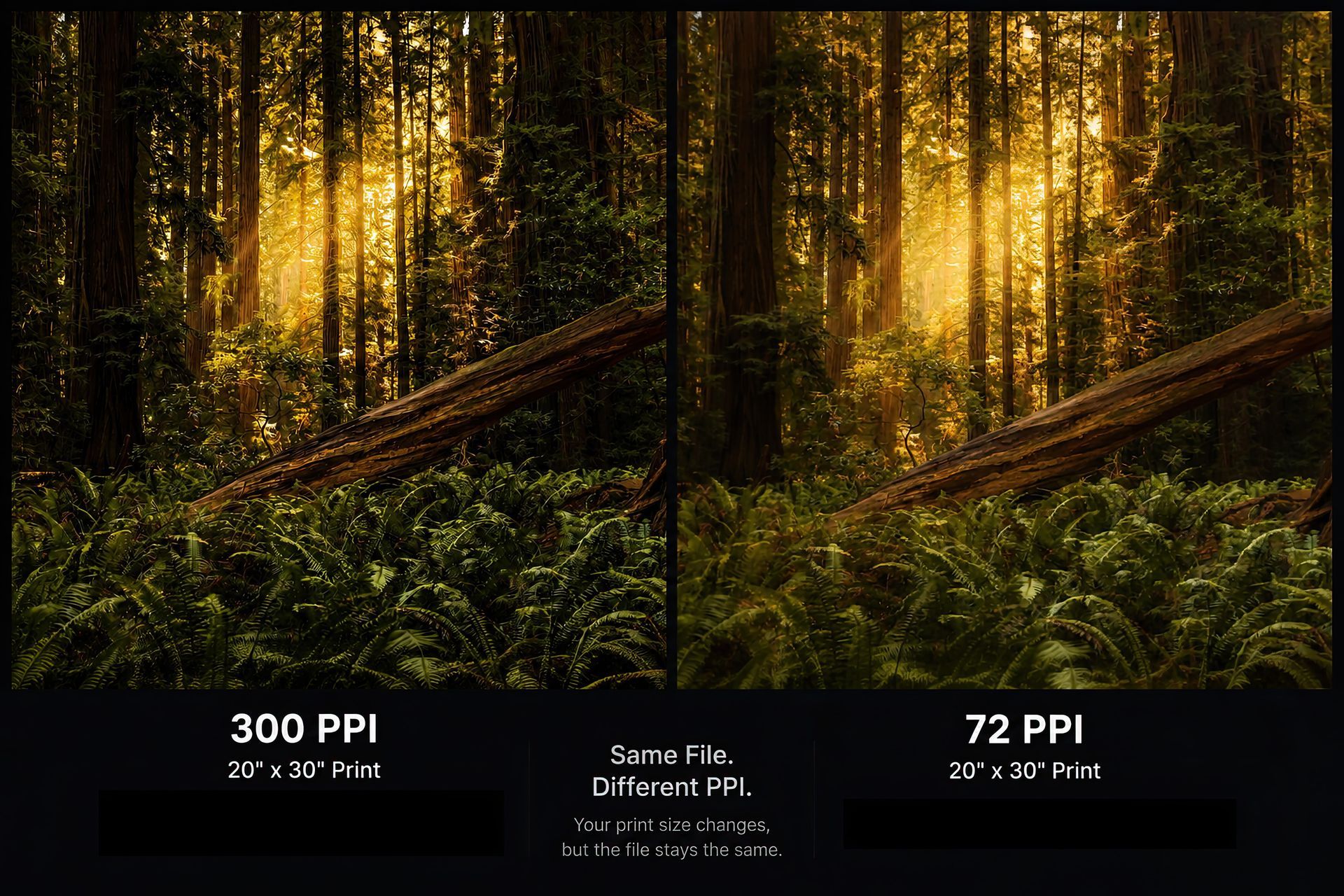
You'll often hear resolution measured in PPI, which stands for Pixels Per Inch.
PPI tells us how many pixels will be printed into every inch of paper.
As a general guideline:
300 PPI
Excellent.
Ideal for fine art prints, close viewing, and maximum detail.
240 PPI
Great.
Most photographers would struggle to see a difference compared to 300 PPI.
200 PPI
Very good.
Perfectly suitable for many medium and large wall prints.
150 PPI
Often acceptable for oversized artwork viewed from farther away.
This is why billboards don't need thousands of pixels per inch. They're designed to be viewed from a distance.
Bigger Isn't Always Better
Many people assume they should always print at the largest size possible.
I don't necessarily agree.
Sometimes an image has incredible detail and deserves a 40×60 print.
Sometimes the same photograph has a stronger impact at 16×24.
The right size depends on:
- The amount of detail in the image
- Viewing distance
- Where it will hang
- The emotional impact you're trying to create
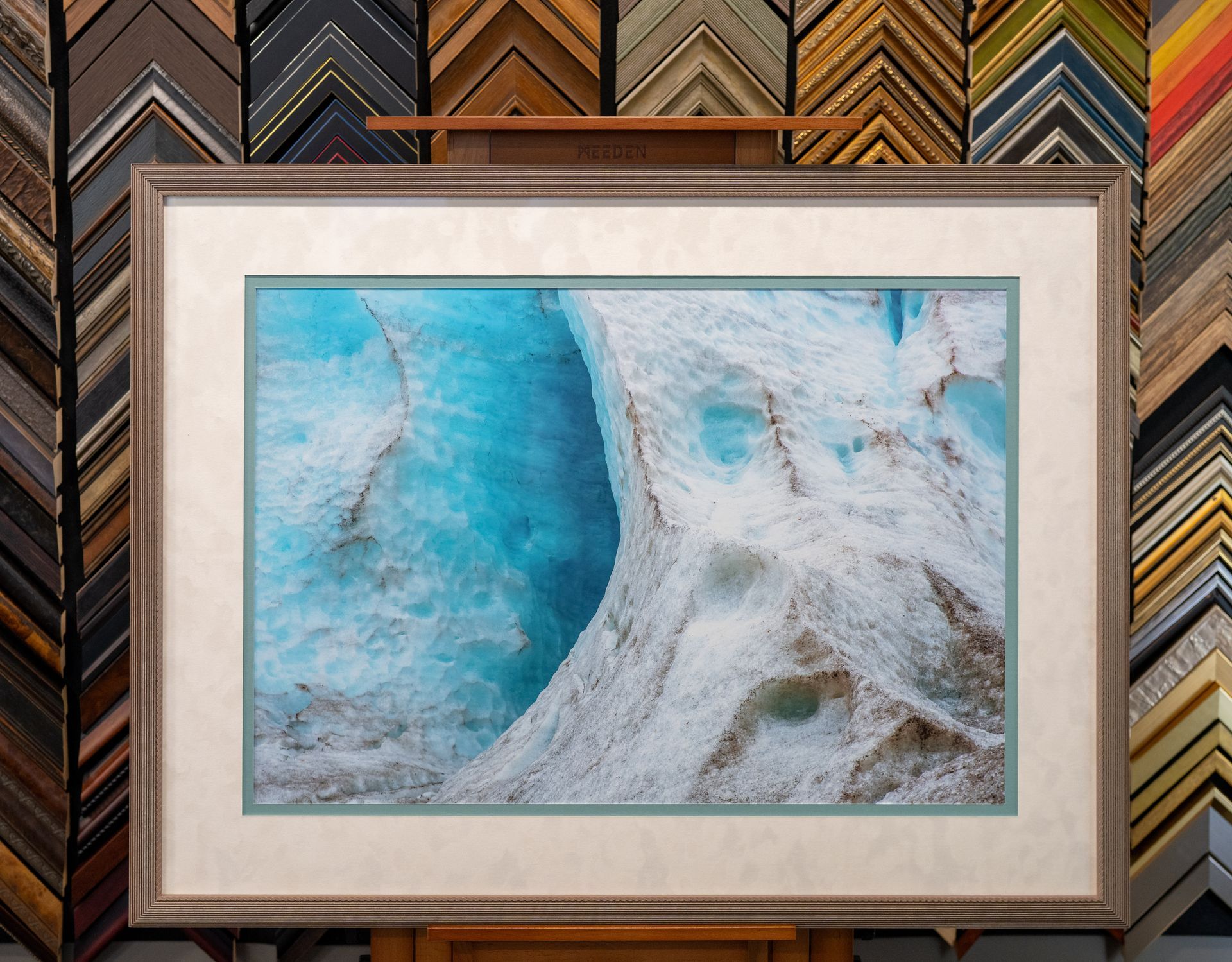
We've seen photographs become more powerful by printing them smaller and giving them room to breathe with a wide mat and custom frame.
Cropping Matters Too
Not every photograph matches standard print sizes.
For example:
A camera may produce an image with a 3:2 aspect ratio.
An 8×10 print uses a 5:4 ratio.
That means some cropping is required.
Our calculator estimates whether cropping will be needed for common print sizes so there are no surprises before you order.
What About Phone Photos?
Modern smartphones are surprisingly capable.
Many newer phones produce files that can comfortably print at:
- 8×10
- 11×14
- 16×20
Some can even produce excellent 20×30 prints under the right conditions.
The biggest limitation usually isn't the phone.
It's whether the photo is sharp and taken in good light.
Can AI Make My Photo Larger?
AI enlargement software has improved over the past few years.
Sometimes it can produce impressive results.
Sometimes it simply creates believable-looking detail that wasn't actually there.
We generally recommend starting with the original file whenever possible.
If enlargement is necessary, we'll let you know whether AI is likely to improve the final print.
Our Recommendation
Use the calculator as a starting point, not as the final answer.
It provides an excellent estimate based on your file's resolution.
If you're investing in a large print or custom-framed piece, we'd much rather spend a few minutes reviewing the image than have you order something you're unsure about.
Sometimes we'll tell you it can go even larger than the calculator suggests.
Sometimes we'll recommend scaling back.
Either way, our goal is to help you end up with a print you'll be proud to hang on your wall.
Frequently Asked Questions
Does a larger file always make a better print?
Not necessarily.
A large image that's soft or blurry won't print as well as a smaller image that's sharp and properly edited.
Can I print an image from Facebook or Instagram?
Usually not at large sizes.
Social media platforms compress images to reduce file size, which removes detail.
Whenever possible, use the original file from your camera or phone.
What if my image isn't large enough?
Depending on the image, we may be able to recommend a smaller print size or discuss AI enlargement options.
Why does your calculator say cropping is required?
Your image and the print size use different aspect ratios.
This is completely normal and affects many photographs.
Should I trust the calculator or ask Capture On?
The calculator is a great starting point.
If you're ordering a statement piece or custom framing, we're always happy to review your file and make a recommendation.